
How can brands achieve long-term success on Amazon with efficient ad spend?
On Amazon, relying on either SEO or PPC alone isn’t enough to drive consistent growth. While SEO builds organic visibility, PPC targets high-intent traffic, driving sales velocity. The real game-changer comes when SEO and PPC strategies work together, creating a cohesive approach that maximizes visibility, improves conversion rates, and drives consistent sales growth.
In this blog, we’ll explore how combining Amazon SEO and PPC can lead to more efficient PPC campaigns, maximized visibility, lower customer acquisition costs, and higher long-term returns.
Table of Contents
- Role of Amazon SEO in Driving Advertising Success
- Role of Amazon PPC in Driving Advertising Success
- How to Integrate Amazon PPC and SEO Together
- The Impact of a Combined Amazon SEO and PPC Strategy
Role of Amazon SEO in Driving Advertising Success
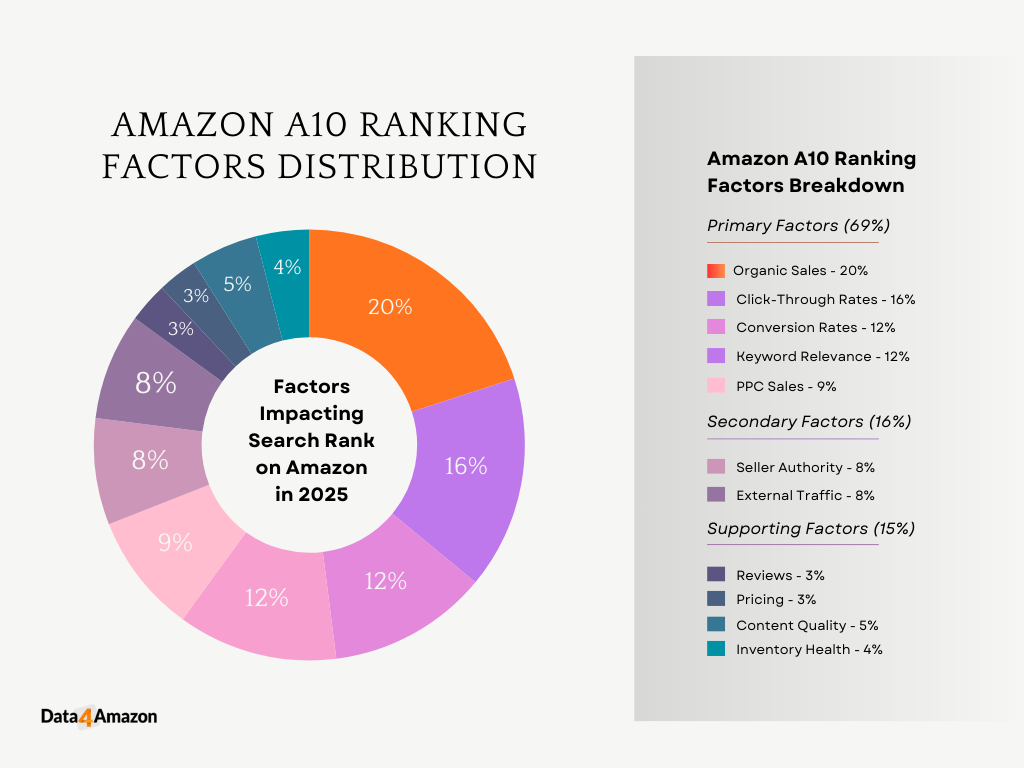
SEO establishes the foundation for organic visibility by aligning product listings with the Amazon A10 ranking algorithm, which determines search placement based on relevance, engagement, seller authority, and sustained sales performance.
Higher Relevance Improves Conversion Rate
Product listings optimized with precise keyword relevance reduce friction between search queries and shopper expectations. When a product appears organically for a search term that accurately reflects its attributes, use cases, and benefits, shoppers are more likely to engage and convert.
For instance, a listing optimized for “ergonomic office chair for long hours” performs more effectively in organic search when the title, bullet points, and content clearly support extended sitting comfort, posture support, and work-from-home use cases. This alignment ensures that shoppers encounter immediate relevance rather than generic messaging, leading to stronger engagement and higher conversion rates.
Organic Visibility Reduces Long-Term Customer Acquisition Cost (CAC)
Amazon SEO requires upfront investment in listing optimization, keyword strategy, and A+ content, but it reduces acquisition costs over time by lowering dependence on paid traffic. Once a listing gains stable search placement, incremental sales are generated without a proportional increase in advertising spend.
CAC = Total Marketing Spend ÷ Number of Customers Acquired
When relying solely on paid traffic, total marketing spend must scale proportionally with sales volume. In contrast, when organic visibility consistently contributes to sales, total spend remains relatively stable while customer acquisition volume increases, resulting in a lower CAC over time.
For example, a product that requires $5,000 per month in ad spend to generate 500 sales has a CAC of $10. If search-driven visibility later contributes an additional 200 sales without increasing spend, CAC drops to approximately $7.14, even though overall sales volume increases.
Want to Optimize Your Amazon Listings for Better Search Rankings?
Leverage expert Amazon SEO services to optimize product descriptions, enhance A+ content, keyword optimization, and competitor research to improve search ranking.
Role of Amazon PPC in Driving Advertising Success
Sponsored Product Ads: Driving Performance and Sales at the ASIN Level
Sponsored Products ads promote individual listings within search results and product detail pages, positioning products directly in front of shoppers who are actively comparing options.
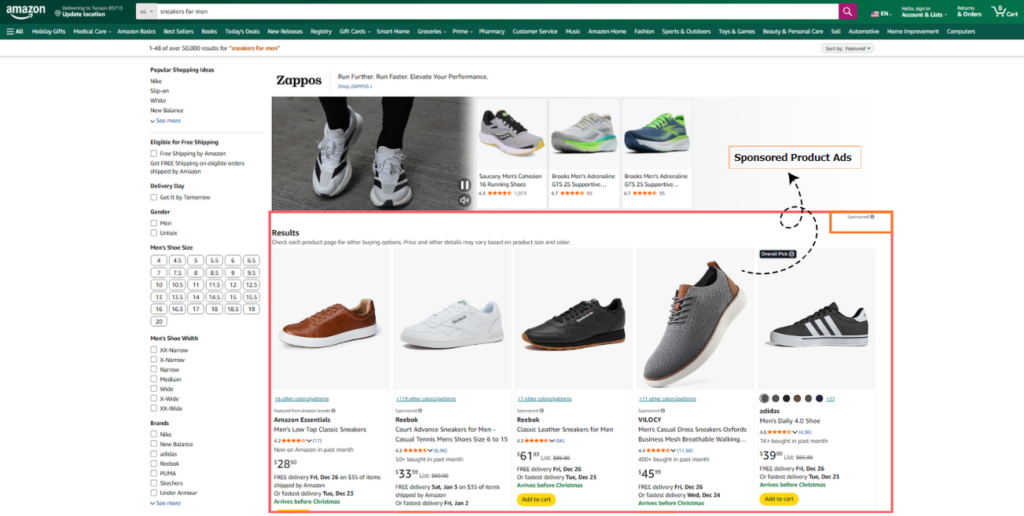
They are most effective for:
- Capturing high-intent shoppers through keyword-driven placements in search results and the “Products related to this item” section
- Accelerating sales velocity for individual ASINs, particularly during product launches or when improving organic ranking
- Maintaining consistent exposure within competitive categories where multiple sellers compete for the same search terms
Sponsored Brand Ads: Building Brand Visibility and Category-Level Consideration
Sponsored Brands ads appear prominently at the top of search results and showcase a brand logo, headline, and a curated selection of products. These placements support brand discovery and guide shoppers toward a broader product portfolio.
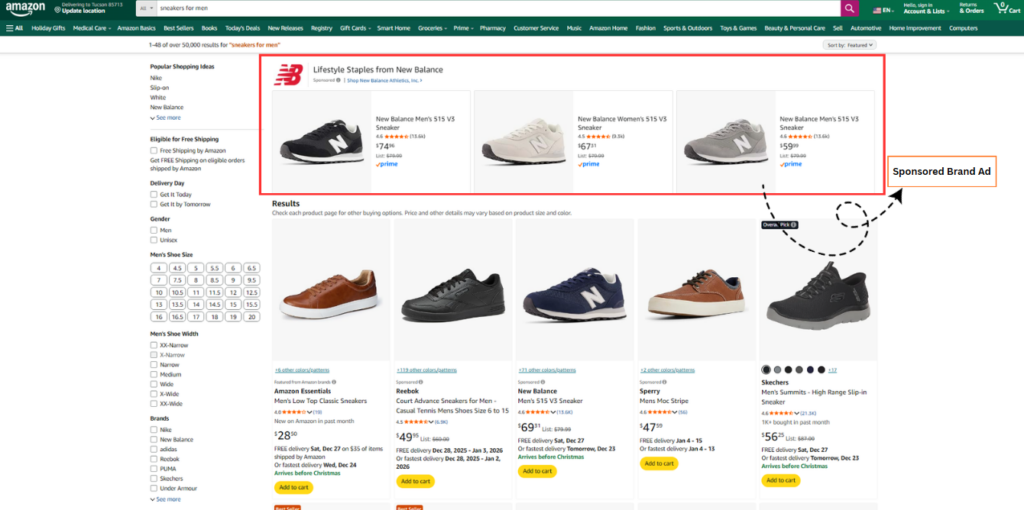
They are effective for:
- Establishing brand presence through premium top-of-search visibility during active shopping sessions
- Directing shoppers to brand stores or curated product collections rather than a single listing
- Protecting branded search terms and reinforcing category authority against competing brands
Sponsored Display: Extending Reach through Retargeting and Contextual Placement
Sponsored Display ads enable brands to re-engage shoppers who have previously interacted with their products while also reaching new audiences through behavioural targeting. These ads appear across Amazon, on product detail pages, and on third-party websites and apps within Amazon’s advertising network.
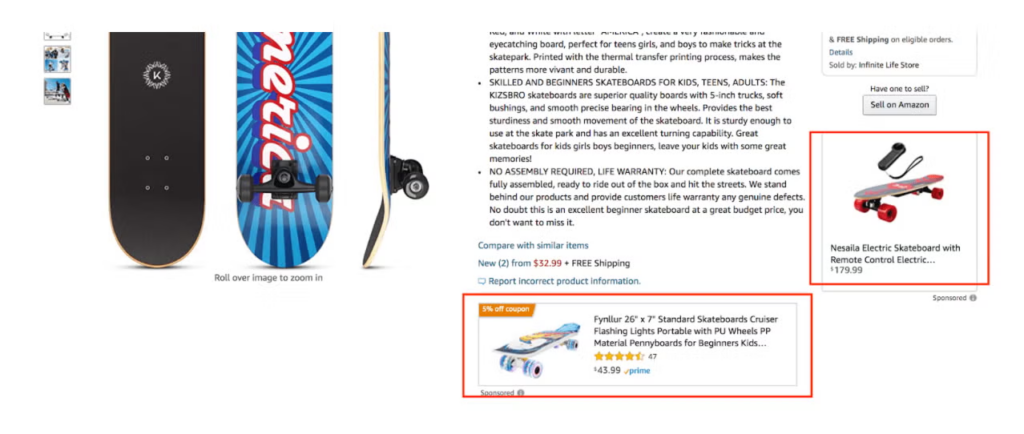
They are effective for:
- Re-engaging shoppers who viewed products but did not complete the purchase
- Reaching new audiences through contextual targeting on relevant product pages, lifestyle and interest-based segments, and lookalike audiences
- Maintaining visibility for key product listings against competitor ads
- Expanding brand visibility through off-Amazon placements
The Role of Amazon PPC on Search Visibility and Sales Velocity
Immediate Visibility and Competitive Placement
While organic ranking takes time and requires consistent performance across multiple factors, Amazon PPC enables immediate visibility in search results. With competitive bidding, brands can secure prominent placements—including top-of-search positions—for high-intent keywords, maintain visibility during promotional periods, and capture traffic that would otherwise require weeks or months to access organically.
PPC also protects branded search terms from competitor encroachment, ensuring your brand maintains its position when customers search for it by name. This defensive strategy is particularly valuable in highly competitive categories dominated by well-established brands with strong sales histories, where gaining top organic placement can be slow or difficult.
PPC as a Source of Keyword and Intent Intelligence
Amazon PPC campaigns generate actionable data on:
- Search terms that drive conversions
- Keyword match types that perform most efficiently
- Buyer intent patterns across variations and modifiers
For instance, PPC data-driven analytics reflect that “wireless mouse for MacBook” converts at a significantly higher rate than “wireless mouse,” even when search volume is lower. These insights directly influence SEO keyword prioritization and Amazon listing optimization to align with high-converting search terms.
PPC Accelerates Sales Velocity and Supports Organic Ranking
Sales velocity remains a core ranking signal within Amazon’s ecosystem. Strategically managed PPC campaigns help generate early traction for new listings, reinforce ranking improvements for priority keywords, and stabilize performance during seasonal fluctuations.
Need to Improve Your Amazon Ad Campaign Performance?
Leverage Amazon PPC to target high-intent customers, optimize ad placements, and accelerate sales growth.
How to Integrate Amazon PPC and SEO Together
Step 1: Establish a Unified Keyword Framework
The foundation of a successful SEO and PPC strategy begins with comprehensive keyword research. Both SEO and PPC should align on primary search terms, feature-based modifiers, use-case variations, and long-tail phrases.
For example;
- Primary Search Term: “ergonomic office chair.”
- Feature-Based Modifiers: “adjustable office chair,” “lumbar support.”
- Long-Tail Keywords: “ergonomic office chair for long hours,” “best office chair for back pain.”
While PPC can be used to test the competitiveness and conversion potential of these terms (for example, identifying which keywords drive more conversions at a low CPC), SEO focuses on sustainable ranking opportunities by targeting keywords that not only drive traffic but also align with buyer intent over the long term. PPC allows you to validate the potential of keywords before investing heavily in SEO optimization.
Step 2: Use PPC Search Term Data to Optimize SEO
Amazon pay-per-click campaigns provide actionable insights into which search terms drive conversions and which underperform. By analyzing these search term reports, you can refine your SEO strategy to match buyer intent and optimize for high-converting queries.
For instance, if your PPC campaign shows that “ergonomic desk chair for long hours” is converting at a higher rate than “ergonomic chair,” incorporate this long-tail term into your product titles, bullet points, and backend keywords for SEO optimization. This ensures your listing remains aligned with actual buyer behavior.
Additionally, PPC can help you identify irrelevant traffic and refine your targeting in SEO by excluding keywords that don’t contribute to conversions or don’t match your product’s actual use-case.
Step 3: Align Amazon PPC Campaign Structure With SEO Goals
The structure of your PPC campaigns should be designed to support SEO-driven objectives. Whether it’s accelerating rankings for high-priority keywords, increasing efficiency, or defending your branded terms, your PPC campaigns should be strategically aligned to complement and reinforce your SEO goals.
For instance, if SEO efforts focus on ranking for a term like “ergonomic office chair for home use,” your PPC campaigns should target the same term, and you may also run separate campaigns to target branded defense for your specific product name. This way, you’re consistently reinforcing the same keyword targets across both channels, while also protecting your brand’s visibility and capturing higher intent traffic.
Moreover, segment your PPC campaigns based on buyer intent:
- Top-funnel: Target broad keywords (e.g., “office chair”)
- Mid-funnel: Target feature-based or comparative keywords (e.g., “best ergonomic chair”)
- Bottom-funnel: Target high-intent, long-tail keywords (e.g., “buy ergonomic chair with lumbar support for long hours”)
This segmentation ensures PPC is aligned with both short-term visibility and long-term ranking objectives.
Step 4: Optimize Amazon Listings Before Scaling Advertising Spend
Scaling PPC spend without first optimizing your product listings for SEO can lead to inefficient ad spend. Listings must be fully optimized for relevance and conversion before increasing advertising budgets. Otherwise, you’re simply driving traffic to a suboptimal listing, which wastes both paid media spend and growth opportunities.
For instance, imagine you’re running ads for the keyword “ergonomic office chair,” but your listing title only mentions “office chair” and doesn’t include key features like “ergonomic” or “lumbar support.” This mismatch can drive low-quality traffic, leading to higher CPC and lower conversion rates. Optimizing your product title, bullet points, and content with relevant terms improves your listing’s conversion rate, ensuring that as you scale your ad budget, ROI on ad spend increases as well.
Listings should be optimized to meet the following criteria:
- Relevant keyword coverage: Ensure your keywords appear naturally in titles, bullet points, and product descriptions.
- Clear value propositions: Address buyer pain points and decision-making factors (e.g., comfort, price, features).
- Conversion optimization: Ensure product images, reviews, and A+ content are aligned with buyer expectations and highlight key benefits.
The Impact of a Combined Amazon SEO and PPC Strategy
| Benefits of Amazon SEO | Benefits of Amazon PPC | The Synergy of Amazon SEO + Amazon PPC |
|---|---|---|
| Sustainable organic visibility without ongoing ad spend | Immediate visibility and competitive placement | Dual placement dominates search results, maximizing visibility across the buyer journey |
| Keyword targeting based on buyer intent and relevance | Real-time data on high-converting search terms | PPC identifies high-intent keywords; SEO integrates them into listings for compounding organic performance |
| Improved organic rankings over time | Competitive defense for branded search terms | SEO builds ranking while PPC protects brand keywords, ensuring dominance and blocking competitor encroachment |
| Enhanced engagement through optimized content | Increased sales velocity | SEO enhances relevance and drives higher conversion rates, while PPC boosts targeted traffic. Together, they accelerate revenue and improve listing performance |
| Reduced paid advertising dependency as ranking improves | Targeted traffic for high-intent keywords | Higher organic traffic share decreases TACoS, improving long-term profitability |
Increased Visibility & Authority
Combining SEO and PPC allows brands to dominate search results by securing both paid and organic placements. This dual approach ensures consistent visibility across all stages of the customer journey — from initial research to the final purchase decision — giving brands a competitive edge in high-traffic categories.
Improved Ranking Stability
PPC-driven sales help reinforce organic ranking signals, while SEO improvements reduce the need for continuous high bids. As SEO strengthens over time, ad spend can be optimized to focus on high-value keywords, resulting in more consistent keyword positions and reduced volatility, even during promotional cycles or budget fluctuations.
Lower Blended Customer Acquisition Costs (CAC)
As organic traffic grows, it offsets paid spend, reducing customer acquisition costs (CAC). The combined strategy ensures that paid ads convert more efficiently, lowering the overall blended cost of acquisition. This creates a more profitable marketing model as you scale.
Continuous Data-Driven Optimization
An integrated strategy creates a data-driven feedback loop where key performance metrics such as CTR, conversion rate, and ACoS continuously inform both PPC and SEO efforts. PPC data provides insights into high-converting keywords to refine SEO strategies and improve organic visibility. This iterative optimization process, driven by actual shopper behavior and performance metrics, ensures ongoing improvements across both paid and organic channels, resulting in more efficient, scalable growth.
Ready to Scale Your Brand on Amazon?
Leverage Amazon SEO services for organic ranking and Amazon PPC management services to capture high-intent traffic, integrated into a comprehensive Amazon marketing strategy.